
The Double Invisible (Disability and STIs)
There is a pervasive, deeply damaging myth that dictates who is "allowed" to be a sexual being. Society readily hands the narrative of romance, desire, and physical intimacy to able-bodied individuals. But when the subject of sexuality intersects with physical or cognitive disability, the societal narrative violently halts.
Disabled individuals are frequently forced into one of two false categories: they are either infantilized and presumed to be completely asexual, or they are hyper-sexualized and fetishized. The radical, ordinary truth—that disabled people have vibrant sex lives, complex desires, and the exact same biological vulnerabilities to infectious diseases as anyone else—is systematically erased.
When a disabled individual contracts a sexually transmitted infection (STI), they enter a unique void. They face a compounded burden known as the "double stigma" or the "double invisible." First, they must navigate a world designed to ignore their physical or cognitive reality. Second, they must navigate the profound shame society attach to the virus they carry. To live at this intersection requires navigating a medical and social landscape that is frequently fundamentally hostile to their existence.
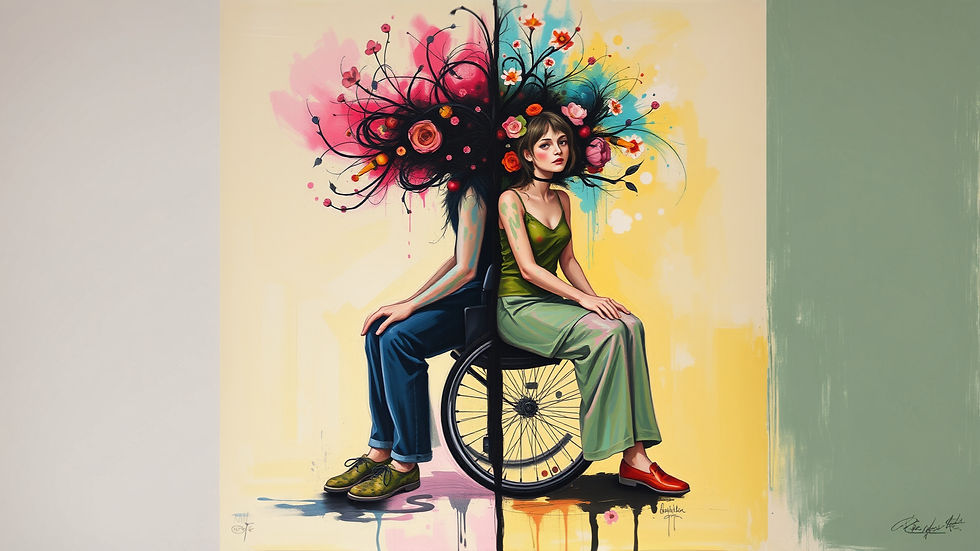
The Myth of the Asexual Body
The erasure of disabled sexuality begins long before a clinical diagnosis. It begins in the absolute failure of sexual health education.
Because society operates under the false assumption that disabled individuals are not having sex, they are systematically excluded from sexual health discourse. Public health campaigns regarding PrEP, the U=U consensus, or HPV vaccinations almost never feature disabled bodies. Educational materials on condom negotiation or navigating consent are rarely adapted for neurodivergent learning styles or made accessible for the visually or hearing impaired.
This educational exclusion has a devastating consequence: it leaves disabled individuals biologically vulnerable. When a person is taught that their body is not meant for sex, they are stripped of the vocabulary and the tools required to protect themselves during intimacy.
When a disabled individual does contract an STI, the reaction from the medical establishment is often one of profound, insulting shock. Instead of receiving standard, pragmatic sexual health care, they are frequently met with interrogations. Doctors may express disbelief, or worse, bypass the individual entirely to discuss the diagnosis with a caretaker or a parent, completely stripping the disabled adult of their medical privacy and bodily autonomy.
The Architecture of Exclusion
Managing a chronic infectious disease—whether it is HIV, Hepatitis C, or navigating routine testing for bacterial STIs—requires consistent access to healthcare. However, the physical reality of the modern STI clinic is often an architecture of exclusion.
Accessibility is not merely about having a ramp at the front door. True accessibility is measured in the examination room. When a wheelchair user needs a routine cervical screening (Pap smear) or an anal swab, they frequently encounter examination tables that cannot be lowered. They are forced to endure the humiliation and physical danger of being manually lifted by untrained staff, or worse, they are simply turned away and told the clinic "cannot accommodate" them.
For the Deaf and Hard of Hearing community, a positive diagnosis of an STI is often delivered without the presence of a qualified sign language interpreter, leaving the individual to decipher complex medical regimens through lip-reading or hastily written notes. For neurodivergent individuals, the harsh fluorescent lighting, the chaotic waiting rooms, and the rushed, jargon-heavy communication style of medical professionals can trigger profound sensory overload and intense anxiety.
This structural violence directly impacts biological health. When going to a clinic is an exhausting, humiliating, or physically impossible ordeal, testing is delayed. Treatment is missed. The virus is allowed to thrive not because the individual is irresponsible, but because the healthcare system refuses to build a door they can walk or roll through.
Compounded Vulnerability and Consent
To discuss disability and STIs honestly, one must confront a grim statistical reality. Disabled individuals, particularly women and individuals with cognitive disabilities, face exponentially higher rates of sexual assault and domestic violence compared to the able-bodied population.
This means that the intersection of disability and infectious diseases is not always the result of consensual exploration. Often, an STI diagnosis is the physical remnant of trauma.
Navigating sexual health in this context requires trauma-informed care. If a disabled individual needs Post-Exposure Prophylaxis (PEP) after an assault, they must navigate a justice and healthcare system that frequently does not believe disabled victims. The power dynamics are profoundly skewed. When an individual relies on a partner or a caretaker for physical survival—for help bathing, eating, or moving—reporting an assault or demanding condom use becomes incredibly dangerous. The fear of losing vital life-support care traps many disabled individuals in situations of high biological and physical risk.
True harm reduction for the disabled community must therefore center relentlessly on the concept of absolute bodily autonomy. It requires empowering individuals with the absolute right to say "no," to demand protection, and to access emergency medical care independent of their caretakers.
The Complex Choreography of Disclosure
As discussed in earlier chapters, disclosing an STI is a vulnerable act. For a disabled person, disclosure becomes a highly complex, multi-layered choreography.
A disabled individual entering a romantic relationship often already bears the exhausting burden of constantly educating their partner. They must disclose their physical boundaries, explain their mobility aids, or articulate their sensory needs. To add the disclosure of an infectious disease—such as HIV or Herpes—on top of this requires immense emotional stamina.
The self-stigma here is exceptionally heavy. The internal monologue often spirals into a fear of being "too much work." The individual may think, “It is already hard enough to find someone who accepts my wheelchair/my neurodivergence/my chronic pain. If I tell them I also have this virus, it will be the final straw. I will be entirely unlovable.”
This lie must be aggressively dismantled. An individual managing a disability and an STI is not a "burden." They are a complex human being offering a profound level of intimacy.
Disclosure in this context is the ultimate filter. It immediately weeds out partners who lack emotional intelligence, empathy, and the capacity for adult communication. A partner who cannot handle the reality of a managed virus is certainly not equipped to handle the beautiful, complex realities of loving a disabled body.
Asserting the Right to Pleasure
Reclaiming the body is the final, most crucial step. Living with a disability often means viewing the body as a site of medical intervention, pain, or societal limitation. Adding an STI can make the body feel like a permanent hazard zone.
But the body is also wired for immense joy. The right to sexual pleasure, to romantic connection, and to physical touch is a fundamental human right. It is not a privilege reserved for the able-bodied, and it is not revoked the moment a virus enters the bloodstream.
Redefining sex is a cornerstone of disabled intimacy. Intimacy does not have to look like the able-bodied, heteronormative performances seen in media. It can involve adaptive devices, sexual aids, careful positioning, and a profound focus on sensory touch that bypasses physical limitations. If managing an STI requires navigating flare-ups or relying on barrier methods, this simply becomes another collaborative step in the choreography of pleasure.
To live openly as a disabled person managing an infectious disease is an act of fierce defiance. It is a daily demand to be seen as whole. The double invisible becomes visible the moment an individual looks in the mirror and recognizes that their body—exactly as it functions, and exactly with what it carries—is inherently worthy of a magnificent, fearless sex life.
References & Scientific Grounding
World Health Organization (WHO) - World Report on Disability & Sexual Health: Comprehensive frameworks highlighting the severe health disparities faced by disabled populations, explicitly addressing the lack of accessible sexual health education and the structural barriers to STI testing and treatment.
Journal of Interpersonal Violence / Centers for Disease Control and Prevention (CDC): Epidemiological data detailing the exponentially higher rates of sexual assault and intimate partner violence against individuals with physical and cognitive disabilities, and the direct correlation to increased STI/HIV transmission risks.
The Lancet Public Health: Peer-reviewed analyses on the "Double Stigma" phenomenon, exploring how intersectional discrimination (ableism combined with HIV/STI phobia) severely impacts mental health, self-esteem, and healthcare-seeking behaviors.
Disability Rights Education & Defense Fund (DREDF): Advocacy and legal literature regarding the failure of medical institutions to provide ADA-compliant (or globally equivalent) accessible examination equipment, and the systemic denial of trauma-informed, autonomous reproductive and sexual healthcare for disabled adults.
Sexuality and Disability (Academic Journal): Research exploring the psychological impact of the "asexual myth," the importance of adaptive intimacy, and clinical models for empowering disabled individuals to assert bodily autonomy and negotiate safe sex practices.


